Designing support around each learner's rhythm
Learning Rhythms explores how online learning platforms could respond to students’ changing needs through support tailored to their learning rhythms.
Working with a research team in collaboration with Illinois Tech’s Center for Learning Innovation, I translated research on learner pacing into a framework and a set of interface prototypes.


Role
UI/UX Designer
I contributed to platform research and taxonomy development, translated team sketches into digital wireframes, and independently designed the UI system and high-fidelity prototypes.
Team
2 Researchers,
3 UI/UX Designers,
1 Project Manager
Timeline
May 2025 - August 2025
(8 weeks)
The Challenge
Self-paced learning asks students to manage their own time, attention, and effort
Online learning gives students the freedom to study around their lives. It also leaves them to decide when to start, how long to persist, and when to pause. Their available time, energy, and the difficulty of the material can change from one session to the next.
Our platform analysis found that learners could control playback and track completion, but had limited support for understanding whether their pace was working for them.
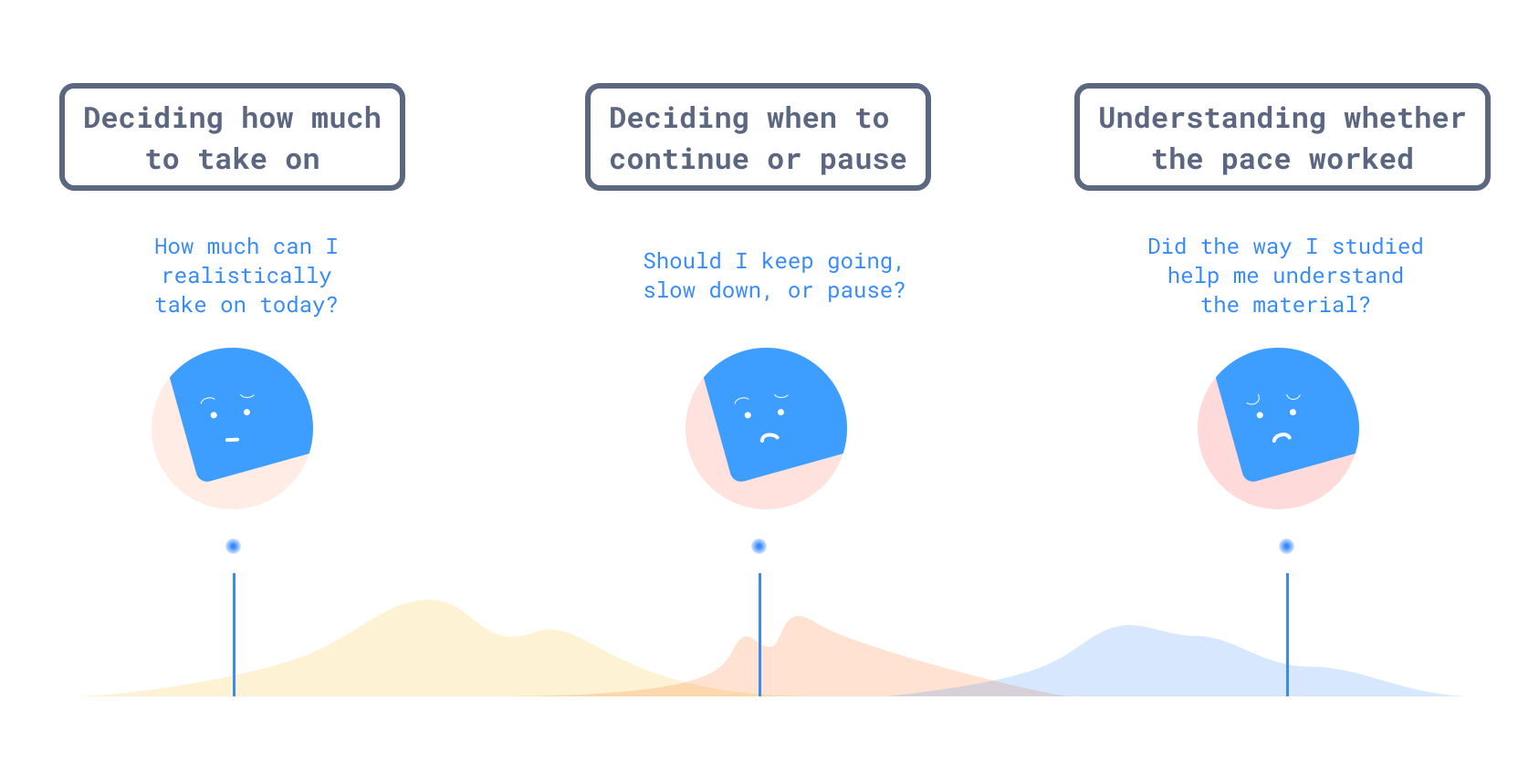
Throughout a session, learners still have to make decisions:
The Concept
Tailoring support's timing, type, and duration to each learner's needs
Learning Rhythms proposes a model for selecting and tailoring support as students move through a course.
The model combines learner profiles, interaction data, learner feedback, and the content before and after a transition. These inputs would inform when an intervention appears, what form it takes, and how long it lasts.
Original learning flow v.s. Proposed learning flow with the adaptive support model
Learner profiles would update after each session to inform future support. Visualizations and reflection tools would also help students recognize their own patterns and adjust how they learn.
Example Scenarios
These scenarios illustrate how different needs could lead to different experiences within the same course.
Maya's learning flow
Sparking interest through a content-related game
Amelia's learning flow
Identifying emotions through a check-in
Research to Framework
Studying how platforms support preparation, pacing, and review
I contributed to a comparative analysis of online learning platforms. We looked beyond the lesson content to the surrounding experience: how students entered a course, prepared for an activity, moved between content, and reviewed their progress.
Findings from different learning stages

Dashboard show completion, but offer limited insight into time use.

Lesson previews introduce content, but give little attention to learner readiness.

Quizzes emphasize correctness, with limited attention to the learning experience.
Mapping interface patterns to opportunities for learner support
I helped develop a taxonomy of learning transitions, organizing interface examples by where they appeared, what they did, and how pacing was controlled.
We then mapped potential forms of learner support to these moments. This helped connect observable interface patterns with opportunities to support confidence, motivation, emotional regulation, and self-awareness.

View the full taxonomy
Concept Development
Exploring interventions before, during, and after a lesson
We used the framework to explore support across three areas: preparing before a lesson, adjusting during learning, and reflecting afterward.
Within each area, we considered different activities and interaction formats that could be adapted to the learner and the situation.

Exploring intervention ideas through team sketches

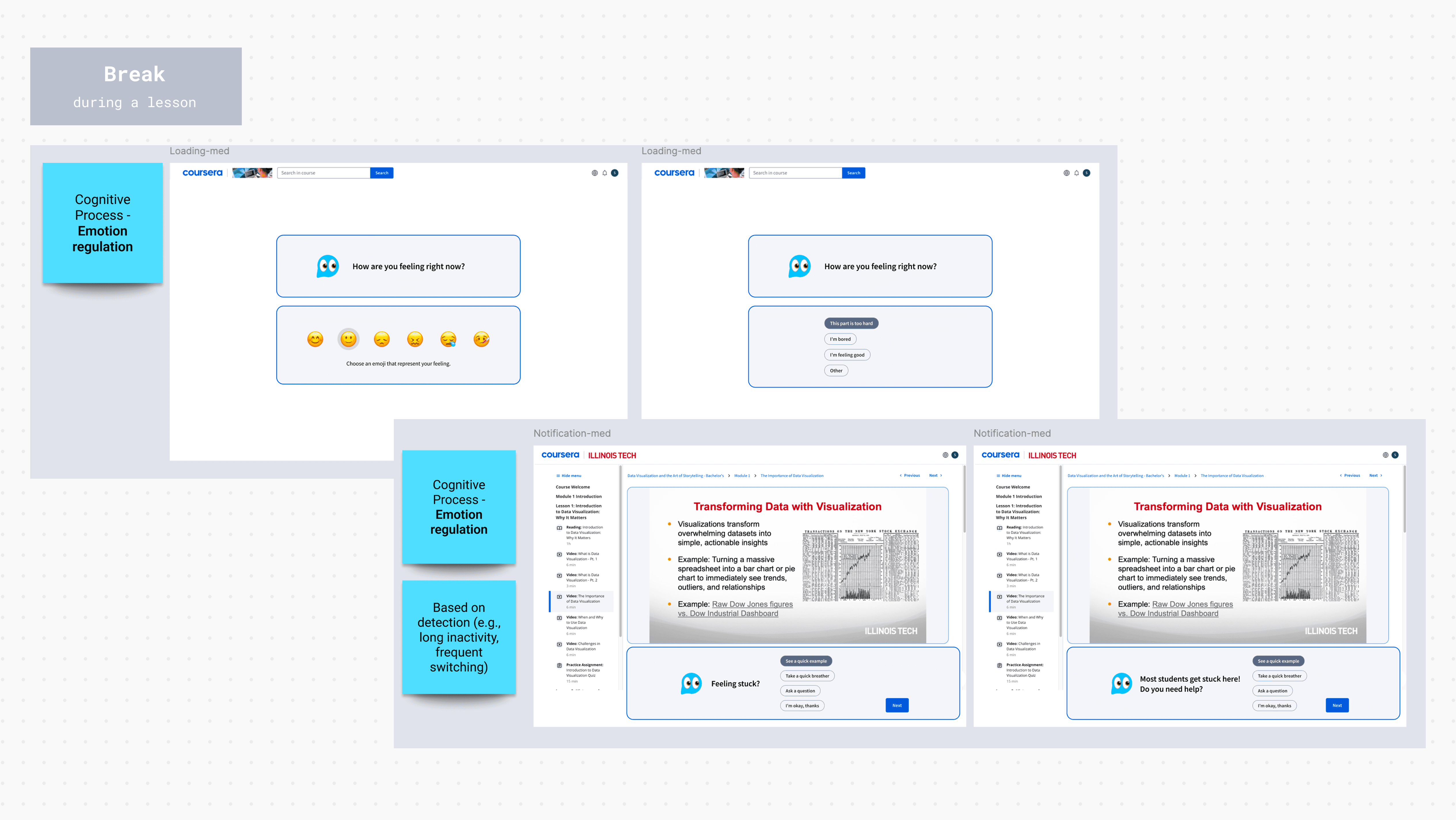

Translating ideas into digital interaction flows
Organizing selected interventions by purpose, duration, and learning stage
We selected a set of interventions, mapping each by its relationship to course content, intended duration, and the learner needs, such as motivation and confidence, it design to support.
These interventions form a set of possibilities within the concept. Their selection and timing would depend on the learner and the context.

Key Moments
Connecting learner input to a session plan
In the preparation flow, I brought together an emotional check-in, available study time, and a proposed session goal.

➂ Make the next step concrete
A proposed goal brings those inputs together with a starting point for the lesson.
➀ Recognize the starting point
A brief check-in invites learners to identify how they feel before beginning.
➁ Bring time into planning
Learners indicate how much time they have available for the session.
Supporting a gentle pause
Suggested Breaktime was explored as part of the learning flow. I designed music experiences with different options and presentation formats, ranging from smaller visuals to a full-page display.

➀ Different levels of immersion
Visual treatments range from smaller graphics to a more immersive full-page experience.
➁ Different forms of support
Motivating and relaxing music options offer different ways to spend a break.
Bringing session reflections and learning patterns into view
I designed the reflection space and student profile to present learning at two scales: what happened in a session, and how learning evolved over time. These views help learners connect individual experiences with patterns they could consider when planning future sessions.

➀ Reviewing performance, time spent, and feelings together
This invites learners to consider their experience together with what they accomplished.

➁ Tracking learning goals, time use, and estimated completion
Learners can see which planned activities are complete or still outstanding, with their daily, weekly, and monthly learning patterns.
Outcome & Reflection
Delivering a learning-transition taxonomy and high-fidelity prototypes
The project produced a taxonomy of learning transitions and a set of prototypes showing how adaptive support could appear across a learning experience.
The research and design work subsequently informed a DRS 2026 paper. My contribution focused on the earlier research and design phase.
Read the paper
The taxonomy helped connect interface decisions to learner needs
Connecting platform observations to learner needs helped turn an abstract taxonomy into concrete design opportunities. The framework gave me a way to connect interface decisions to a purpose: what need they addressed, where they belonged in the learning journey, and why they might be useful at that moment.